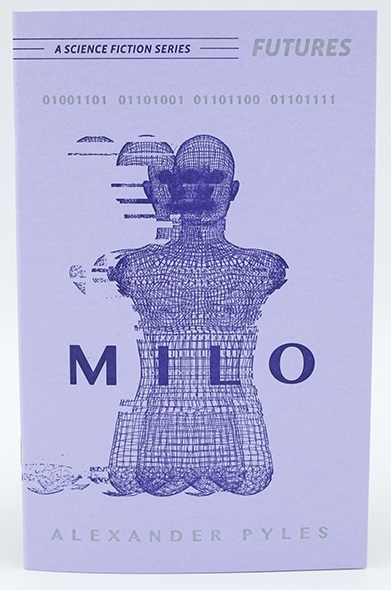
 01001101 01101001 01101100 01101111 00100000 01101001 01110011 00100000 01100111 01101111 01101111 01100100 (Milo is Good). That’s my short review of fellow Seton Hill alumni Alexander Pyles’ excellent chapbook. It was published by Radix Media as part of their Science Fiction Futures Series. The company did a superb job of elevating the traditional chapbook into a more prestigious format. Aside from the stellar layout, the cover and interior art by Nico Roxe is stunningly original. So, what makes the story 01100111 01101111 01101111 01100100 (good)?
Spoilers Below
Well, I’ve already demonstrated one of my favorite elements. Pyles has his protagonist occasionally thinking in binary, which is rendered in the same manner I illustrated above. This is a uniquely cool idea, and it works perfectly in this tale. Milo, the namesake of the narrative, is a disabled man who decides to have his brain removed from his body and inserted into a robotic one. Things are great, at first.
There are two different elements at play in Milo that I really enjoyed. The first is the way the story reminded me of the horror inherent in the isolated brain trope, wherein a character has their brain removed from their body. My favorite example of this trope is in H.P. Lovecraft’s The Whisperer in Darkness, but Milo is not a horror tale. Pyles just renders Milo’s situation so well that readers will find themselves unnerved by the presentation of the character coming to grips with not having a body.
The second element is Milo’s slow loss of humanity in his robot form. At first, Milo only thinks in binary occasionally, but, by the end of the narrative, he only thinks in binary. This reminded me of moments in Paul Verhoeven’s classic, Robocop. Except, in this case, the robotic components consume the human, instead of the human transcending “literal” programming. The reader is left wondering what it means to be human, and I believe that is precisely the response the best science fiction should inspire in readers.
To conclude, Milo is an excellent story. It’s original, and it makes you think about fundamental questions we need to be discussing as a society. On top of that, you can pick up a copy without breaking your bank, and you’ll be getting a gorgeous piece of art to display on your bookshelf. You can also spring for a copy of the entire Science Fiction Futures collection from Radix Media and discover what the other entries in the series have to offer. I’m sure the quality is just as good as Milo. It’s a great time to be a reader when a chapbook can pack so much punch, but I’d certainly be interested in spending more time in Milo’s world if Pyles wanted to expand the tale further.
Read more of my work
View all my Goodreads reviews